How IWMI Replaced Fragmented Manual Processes With a Centralised Workflow System That Actually Works

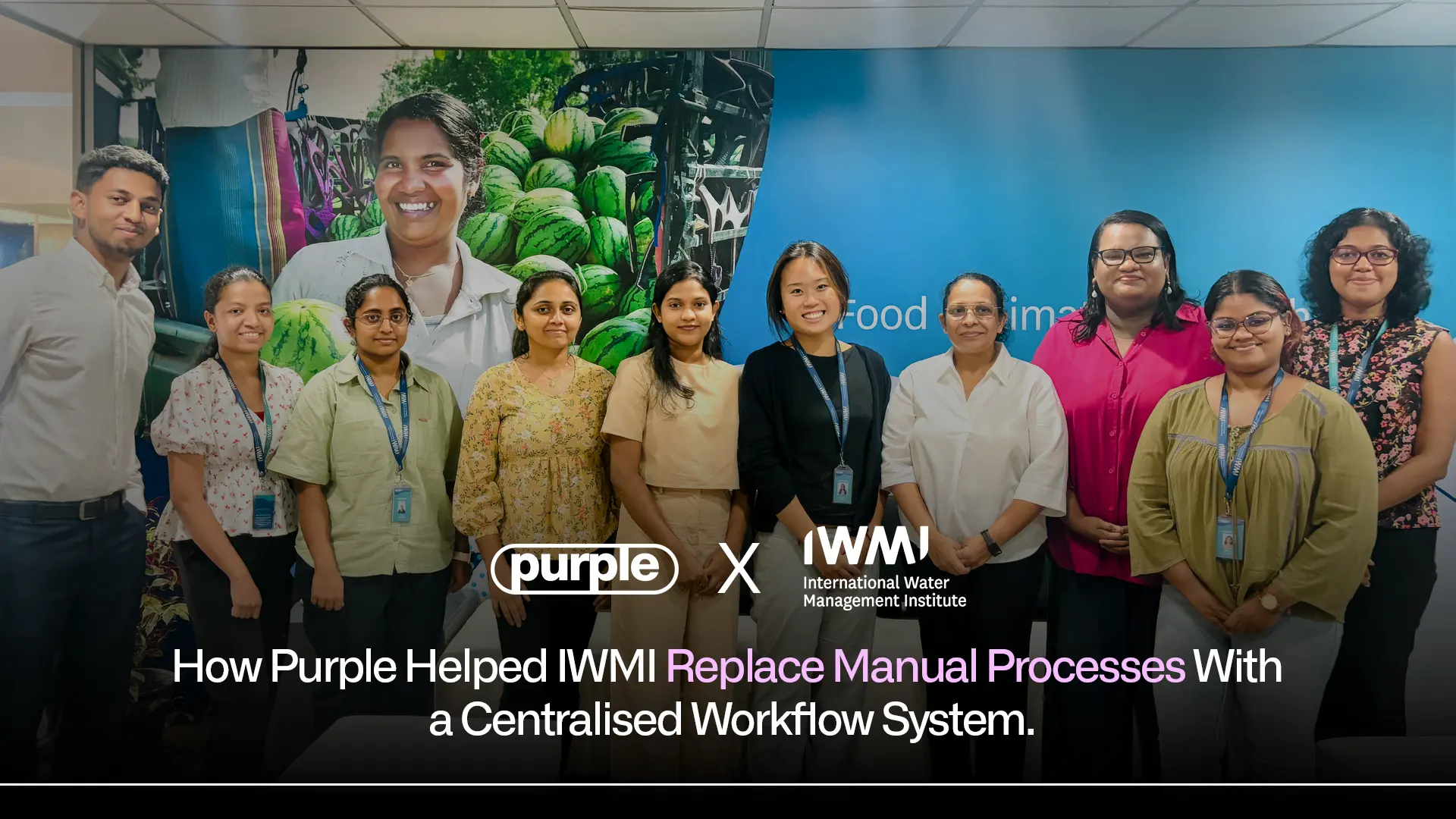
When an organisation operates across multiple countries, manages a complex project pipeline, and relies on committees to make funding and proposal decisions, the administrative overhead of keeping everything coordinated can quietly become one of the biggest drains on the team's time and attention.
This was the situation facing the International Water Management Institute. IWMI is a research organisation operating globally, with teams managing business development opportunities, proposal reviews, and project workflows across multiple stakeholders and approval layers.
The processes holding all of this together were fragmented. Information lived in different places. Updates required manual follow-up. Visibility into the status of any given opportunity or proposal depended on who you asked and when.
The goal was not to add another tool to the mix. It was to replace the fragmentation with something that actually held together.
What Was Breaking Down
Fragmented workflows have a specific texture that anyone who has worked in a complex organisation will recognise immediately.
You send an email to find out where something stands. The person you emailed is waiting on someone else. That person sent a document last week but is not sure if it was reviewed. The review committee meets monthly and the next meeting is three weeks away. By the time the information you needed arrives, the window you needed it for has passed.
In a business development context, this kind of fragmentation has a direct cost. Opportunities slip through because nobody had a clear view of the pipeline. Targets are tracked inconsistently because the tracking lives in individual spreadsheets rather than a shared system. Proposals move slowly through review because the process depends on manual coordination rather than a structured workflow with clear steps and automatic notifications.
For IWMI, the specific pain points centred on two distinct workflows that were each carrying their own coordination overhead.
The first was the Business Development Unit workflow. Managing the opportunity pipeline, tracking against targets, coordinating activities across the BDU team, and maintaining visibility into where each opportunity stood required a level of manual effort that was consuming time the team should have been spending on the actual business development work.
The second was the FORT Member workflow. Proposal reviews and voting involved a committee-based process that was particularly vulnerable to coordination delays. Getting proposals in front of the right people, tracking who had reviewed what, managing the voting process, and communicating outcomes all happened through a patchwork of emails and manual follow-ups that made the process slower and less transparent than it needed to be.
The Solution: One Platform, Two Dedicated Workflows
Purple Software implemented a centralised Workflow Management System built on Monday.com, designed specifically around IWMI's existing processes rather than requiring the organisation to adapt to a generic template.
The decision to build on Monday.com rather than a custom platform was deliberate. IWMI needed something their teams could own and manage going forward, not a system that required a developer every time something needed to change.
Monday.com provided the flexibility to build structured, automated workflows while remaining accessible to non-technical users once the implementation was complete.
The BDU Staff Workflow
The business development workflow was built to give the BDU team a single, transparent view of their entire opportunity pipeline.
Every opportunity exists in one place. Status is visible to everyone with access. Targets are tracked against actuals in real time rather than compiled from individual updates. Dashboards surface the information that matters without requiring anyone to pull it together manually.
The workflow also handles the activity tracking and coordination that previously lived in email threads and individual calendars. Tasks are assigned, deadlines are visible, and progress is trackable without requiring a team meeting to establish where things stand.
The FORT Member Workflow
The proposal review and voting workflow addressed the specific coordination challenges of a committee-based process.
Proposals move through defined stages. The right people are notified automatically at each step. Review status is visible to everyone involved. Voting is captured in the system rather than collected through email responses that need to be manually tallied.
The result is a process that is faster because it does not wait for manual coordination at each stage, and more transparent because everyone involved can see where any proposal stands without asking.
What Purple Software Built Around the Platform
The platform implementation was one component of a broader engagement. The real work was in the design, automation, migration, and change management that made the platform usable from day one.
Executive Dashboards
Leadership needed visibility without having to navigate the operational detail of the workflows themselves.
Purple Software built executive dashboards that surface the metrics and status information that matter at the leadership level, automatically updated as the underlying data changes.
Pipeline health, target tracking, proposal volume and status, and team activity are all visible in one view without requiring anyone to compile a report.
Process Automation
Key notifications and process triggers were automated to remove the manual coordination that had been creating delays.
When a proposal reaches a review stage, the relevant committee members are notified automatically. When a deadline approaches, the responsible team member receives a reminder. When a vote is completed, the outcome is recorded and the next step is triggered.
The coordination that previously required someone to monitor and manage now happens without human intervention at each touchpoint.
Data Migration
Existing data from the previous fragmented systems was migrated into the new platform.
This is the step that most technology implementations underestimate. A new system with no historical data requires the team to start fresh, which creates resistance and means the value of the system is not visible until enough new data has accumulated.
Migrating the existing pipeline, opportunities, and proposal history meant the team could see the value of the new system from the moment it went live.
Testing, Training, and Documentation
The handover process was structured to ensure the teams could operate the system independently and confidently after Purple Software's involvement ended.
Testing involved working through real scenarios with the actual users to identify anything that did not match how the team worked in practice.
Training was tailored to the two distinct user groups, BDU staff and FORT members, with each group receiving guidance relevant to their specific workflow.
Documentation was produced at a level of detail that means new team members can be onboarded without external support.
What Changed After Go-Live
The most immediate change was visibility.
Before the implementation, understanding the state of the pipeline or the progress of a proposal required asking people. After, it required looking at the dashboard.
The information that previously existed in email threads, individual spreadsheets, and people's memories became structured, searchable, and visible to everyone with appropriate access.
The second change was speed.
Automated notifications removed the lag that had existed at every handoff point in both workflows. Proposals moved through the review process faster because the process no longer waited for manual coordination. Opportunities moved through the pipeline faster because status updates happened in the system rather than through email chains that could sit unread for days.
The third change was accountability.
When a task is assigned in a system with a visible deadline and a clear owner, the social dynamic around completing it changes. The team is not relying on someone's memory or their responsiveness to a specific email. The task exists in a shared environment where its status is visible to the team.
That visibility creates a different kind of accountability than a follow-up email does.
The overall outcome was what the engagement set out to produce: a structured, centralised, transparent digital workflow that replaced fragmented manual processes and gave each team better visibility into their day-to-day work and the broader pipeline and proposal landscape they are operating within.
Why This Type of Project Matters Beyond the Technology
Workflow implementation projects are sometimes positioned as technology projects. They are not, or at least the technology is the smallest part of what makes them succeed or fail.
The reason IWMI's implementation worked is not that Monday.com is a powerful platform, though it is. It is that the implementation was designed around how IWMI's teams actually work, including the specific stages of their workflows, the distinct needs of their two user groups, and the information that leadership needs to make decisions.
Generic platforms can fall short when they are implemented without considering how the organisation actually works.
The BDU Staff workflow and the FORT Member workflow are not Monday.com defaults. They are purpose-built structures that reflect the specific logic of IWMI's business development and proposal review processes.
Getting that design right required understanding the work before building the system.
This is the principle that applies across every workflow and automation project, whether it is a Monday.com implementation, a custom AI agent, or a bespoke software system.
Technology does not fix broken processes. It amplifies whatever process it is built around.
The work is in the design.
About Purple Software
Purple Software designs and implements workflow systems, AI agents, and custom software for organisations that need their operations to run more reliably, more transparently, and with less manual coordination overhead.
From centralised workflow platforms for international research organisations to AI-powered automation for trading companies and energy sector operations, we design around how organisations actually work rather than how generic software assumes they do.
If your organisation is managing complex workflows through fragmented manual processes and wants to understand what a structured, centralised system would look like, we offer a free session where we map it out together.
Book a free session at purple.lk
Tags: workflow management system, Monday.com implementation, business process automation, centralised workflow, project pipeline management, IWMI workflow, proposal review automation, executive dashboard, digital workflow transformation, workflow automation Sri Lanka